This article comes The Portage County Historical Society News-Letter, 1965
THE ROLE OF MAXWELL FOREMAN RIDDLE AT THE WORLD'S COLUMBIAN EXPOSITION (1893)
by Ralph W. Dexter, Kent State University Kent, Ohio
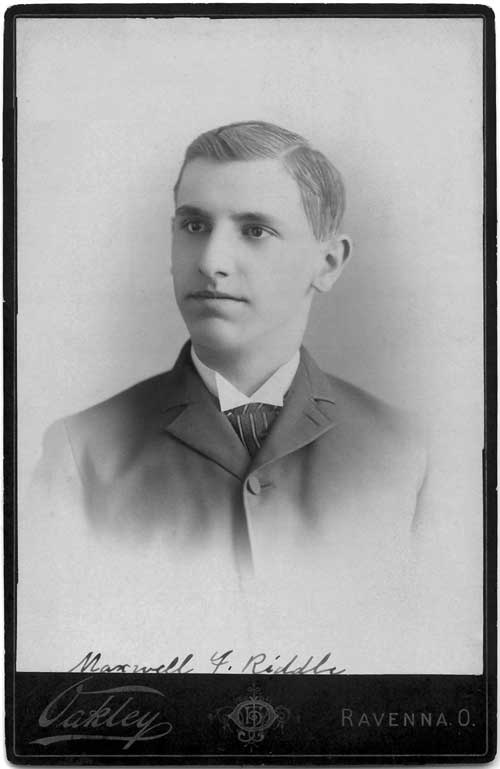 |
| Maxwell Foreman Riddle, picture from The Riddle Archive |
Maxwell Foreman Riddle of Ravenna, Ohio, assisted in the Department of Anthropology at the World's Columbian Exposition in 1893. He made field collections for exhibits and gathered field notes and measurements on Indians in Michigan, Wisconsin, and Minnesota. He worked under the direction of Dr. Frederic W. Putnam, Chief, and Dr. Franz Boas, Chief Assistant, of the Department of Anthropology.
In studying the Putnam papers in preparation for a biography, I encountered some correspondence between Putnam and Riddle concerned with the field studies of Maxwell Riddle.
Acknowledgment is made to the Putnam family for a study of Dr. Putnam's papers and to Maxwell Riddle, nephew and namesake of the subject of this report, for his cooperation.
Dr. Putnam was Curator at the Peabody Museum of American Archeology and Ethnology at Harvard University from l875 to his retirement in 1909. In 1891 he was appointed chief of the Department of Anthropology for the World's Columbian Exposition. He in turn appointed Dr. Boas as his chief assistant. At that time Dr. Boas was associated with the Department of Anthropology at Clark University and later became Professor of Anthropology at Columbia University,
Maxwell F. Riddle was born 8 November 1870 in Ravenna. In 1884 he entered the Ravenna High School graduating in 1888. That fall he entered Harvard University where he became acquainted with Dr. Putnam and his work in anthropology. In the summer of 1891 Riddle carried out field studies and made collections among the Indians in Michigan, Wisconsin, and Minnesota as part of a worldwide program organized by Putnam to obtain scientific specimens and information for exhibits at the World's Fair. Riddle did not continue to engage in scientific pursuits. He turned his attention to promoting business ventures in Mexico, Central America, and South America. Unfortunately, he suffered severe losses as a result of political turmoil in those places. He died in Ravenna on 22 January 1932.
Following are some excerpts from the correspondence between Riddle and Dr. Putnam, relative to Riddle's field studies for the World's Columbian Exposition. On 7 July 1891, Putnam wrote to Riddle who was at that time in Ravenna, "On June 25, Dr. Boas sent you by American Express, two packages containing instruments (to measure Indians in Wisconsin for the World's Fair exhibit on somatology of American Indians under Boas). Dr. Boas left for the north-west about a week ago."
Riddle sent his reply to Putnam on 9 July 1891, reporting that, "The first post to which I have been assigned is Keshena, Shawano County; from there to Ashland, Wisconsin, and then to L'Anse, Michigan. There are also Indians in Oneida County and Sawyer County, but Dr. Boas said nothing about visiting them. Do you think it would be advisable provided I have time?" Eleven days later Riddle wrote again from Keshena, Wisconsin, as follows. "I write you to ask your opinion on the purchase of a number of articles of Indian manufacture to be obtained here. The Indians do not make any garments, tents, or other large articles. The things which can be obtained are bead sashes, moccasins, pipes, etc. I arrived here last Thursday and have been fairly successful since my arrival, having made 87 measurements in three days and a half."
Putnam replied four days later, "I do not think the specimens you mentioned—pipes, bead sashes, etc. are worth purchasing at the prices named. They are hardly characteristic of Indian work and we have a lot of such material already. It is such things as people generally purchase of Indians and they know it, and manufacture them especially for sale. It is the real, old native things that I am after. That which relates to the life and customs of the Indians before their art was ruined by contact with the whites." On 31 July Riddle wrote back to Putnam, "I have not bought any of the work mentioned by you as made to sell to the whites. I have purchased a nearly complete costume as used in the "dream dance". These articles have all been used in this dance and some of them were purchased from the dancers just after they had finished their ceremonies. I saw this dance and can give you an account of it if it will be of any use to you. I am making out as complete a set of field notes as possible under headings of statistics, manners, method of life, etc. Have measured so far 180 persons."
Miss Frances H. Mead, secretary to Dr. Putnam, wrote to Riddle 5 August quoting a comment from Putnam that, "I am very much interested in your account of the 'Dream dance' and by all means take as full notes as possible of all customs, ceremonies, etc. and I should be pleased to receive them from time to time and would make reference to them in my monthly report to the Director-General."
On 8 August Riddle wrote to Putnam from Odanah, Wisconsin, that, "The Chippewa Indians make use of a house of native manufacture during the summer. It is composed of poles covered with birch and cedar bark. I have not inquired particularly as to what they are worth as they immediately put a high price on than when you do, but I think one could be obtained at a very reasonable price. They also use a great many birch-bark canoes which sell at $8, sometimes less. Do you wish me to obtain these things?" To this Putnam replied immediately, "Make arrangements for a house to be delivered next year. Also, for a small canoe-- an old house or old canoe best."
Mrs. Emily H. Riddle, mother of Maxwell, wrote to Dr. Putnam from Ravenna 17 August 1891 enclosing a clipping from The Ravenna Republican with her note. She wrote, "Thinking you might be interested, I send by this mail a little paper published here, containing an extract from a home letter of my son, Maxwell F, Riddle, giving an account of a 'Dream Dance' which he saw among the Indians of Wisconsin." The news account published 15 July 1891 (page 5) read as follows:
"A Ravennian and the World's Fair"
"Maxwell Riddle has been appointed assistant in the Department of Ethnology of the Columbian Exposition. His work for which he left Tuesday will be among the Indians of Northern Wisconsin. The following extract from the Boston Post explains his work and the reasons for having it done.
"A reporter of the Post called upon Professor Putnam at the Peabody Museum in Cambridge, in order to ascertain from someone in authority the present state of progress in World's Fair matters in general and also to obtain a sketch of Professor Putnam's plans for the ethnological and archaeological department of which he is the chief. Among other important matters which Professor Putnam is working out for the Exposition is that of a series of charts of the physical characteristics of the native peoples of America. This special work has been placed in charge of Dr. Franz Boas of Clark University. He has been training a number of students in Clark University and in Harvard University to take the proper measurements and descriptions of individuals. These young men will be sent among the different tribes of Indians. To carry on the work in this connection the cooperation of the officers of the army and navy has been secured and there is no doubt that a large amount of material for the formation of a series of physical charts will be secured. This has never been done for the native peoples of America and as a matter of research it will be regarded with great interest by all anthropologists; in fact Professor Putnam considers this work of very great importance and one that will be highly appreciated. It also shows that the higher aims of science are appreciated and endorsed by the authorities of the Exposition."
Dr. Putnam wrote to Director General Davis of the World's Columbian Exposition in October that, "Mr. Maxwell Riddle has finished his researches for the season and has sent in his field notes which contain very graphic accounts of the life and customs of the Menomonee, Stockbridge, and Chippewa Indians of northern Wisconsin. In these notes descriptions are given of the habitations, summer and winter of the dress; food; industries; customs; religious, tribal, marriage, and burial ceremonies; of the different degrees of civilization; of the Indian schools, etc. These ethnological notes, when obtained from the different Indian tribes by the various workers, will be of the utmost interest both popular and scientific."
At the conclusion of the World's Fair Riddle's collection of Indian specimens and measurements was given along with other similar anthropology collections to form the nucleus for the Field Columbian Museum. This later became known as the Field Museum of Natural History and is today called the Chicago Natural History Museum. Thus, Ravenna had a part in the establishment of this great museum as well as contributing to the exhibits of the World's Columbian Exposition.
articles