
These days most people don't believe in miracles. I didn't either until I witnessed one this past summer. It happened in Northern Laos. Laos is a land-locked country north of Thailand and west of Vietnam in Southeast Asia. It is nearly the size of England but has only about five million people (versus England's 60 million). It is a very pretty mountainous country with wild rivers and deep forests.
It also has the distinction of being the country with the highest ratio of bombs dropped per person of any place on earth. From 1964 to 1973 the US, in 580,344 bombing runs, dropped just over two million tons of bombs on Laos. The idea was to stop the flow of guns and men along the Ho Chi Minh trail from Hanoi to South Vietnam. "Collateral damage" and "civilian casualties"—like we heard about in the Kosovo war—was not a consideration. Everything and everyone in Northern Laos was a target. To us, the Lao people were not quite human.
Even now no one knows how many people were killed or the real extent of the damage, but everyone I talked to had lost a family member in the bombing, and certainly every substantial building was destroyed. With that many bombs dropped it's only natural that some did not explode. The US military claims that 10% of the bombs didn't go off; other people think 30% didn't explode. But the numbers don't really matter: no matter how you figure them, there are an incredible number of bombs waiting for a woman gathering firewood to nudge, a farmer to strike with his hoe, or for a child to play catch with—if they are one of the millions of baseball-shaped anti-personnel bombs that were dropped.
"No matter how you figure the numbers, there are an incredible number of bombs waiting in the ground."

In 1994 an international organisation, the England-based Mines Advisory Group, began a programme to find and explode those unexploded bombs—what they call UXO (Unexploded Ordnance). Last summer they asked me to help them design a database to keep track of how many bombs they had found and destroyed. The 186 fields in the database formed a list of seemingly everything that could possibly fall from the sky. The US military even dumped the bombs they had stockpiled from World War II.
These days MAG has a staff of 200 who have three basic tasks: (1) to teach people what to do when they find a bomb, (2) to clear (de-bomb) land where someone wants to build something, and (3) to explode bombs that people have found.
The educational component lectures, passes out "Just say No to Bombs" T-shirts, and puts up posters to warn people not to pick up unexploded ordnance. Earlier this year they went to a village and passed out the T-shirts to a group of smiling children. The next day, by chance, those same children spotted a bomb on the way home from school. Most of the kids immediately got away from it. One boy, however—the boy who had, ironically, sat in the front row of the bomb-awareness class—started to play catch with the baseball-shaped bomb. He shortly blew himself up.
Whenever someone wants to build a building, a soccer field, or make a road, they contact MAG to come and de-bomb it. And they almost always find bombs. A friend was staying in a guesthouse when MAG stopped by and found a bomb buried outside his window. When I rode in from the airport they were working on a bomb that someone had spotted in the ditch along the road. Once they cleared the ground for a new school and found only three bombs—then the land was landscaped with truckloads of topsoil. Those truckloads contained, to everyone's horror, 35 baseball-sized bombs. The clearance work is incredibly tedious. First they survey the area and mark it off like the yard lines of a football field. Next they, keeping a safe distance from each other, sweep the yard lines with mine detectors. Every bottle cap, nail, and old beer can has to be considered a live bomb until someone proves it otherwise. The de-bombers work in the cold rain, the hot sun, and the dirty mud—all for one hundred dollars a month.
Education and clearance are the boring parts of the job. The fun part is blowing stuff up that people have found. The process begins with a MAG representative visiting a village and asking the headman to compile a list of bombs that people have found. After the representative checks that the bombs are actually there, he sends in a clearance team. I went out with a clearance team one morning and watched Miss Lai—the woman in the photograph above—demonstrate her expertise.
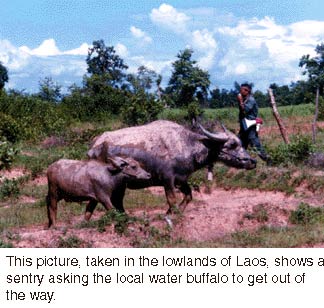
She was one of seven people, excluding the medic, on the team. As soon as we arrived at the site, the four sentries took off with bullhorns and walkie-talkies to clear the area of people, while the technicians strung a few hundred meters of detonator cable from the top of a nearby hill through the valley where a farmer had marked four bombs in his lush pasture. As they strung the cable, they studied the ground for even more bombs, but didn't find any. When the cable was beside all four bombs, the team leader used his walkie-talkie to check in with his sentries. One of them was herding water buffalo out of danger; others had told the people in nearby houses to leave. After a few minutes they gave him the go-ahead.
Miss Lai then put on protective glasses—but no other protective clothing—and inserted a detonator pin into a cigarette-pack-sized block of TNT that MAG had bought from the Russian military "at a very reasonable price." She then did the same thing to the other three bombs.
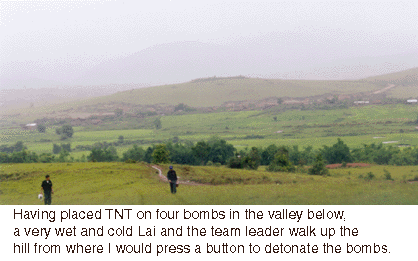
It was raining and cold. I had an umbrella; the demolition experts and the sentries had nothing. (In Asia they've never stopped planting rice just because it's raining—everyone somehow endures it even though they get as cold and sick as we do.)
When the TNT was safely in place we walked to the top of the hill from where we could see the entire valley. The team leader went back to his walkie-talkie—the sentries said that everything looked okay. As the guest of honour, I was given the task of pressing the button that would set off the TNT. I turned a crank that generated a charge, and when a light flashed I pressed the button. Ka-boom! Four white puffs of smoke instantly dotted the valley. We then did a check to make sure that the TNT had actually exploded the bombs and not just pushed them away. It had—where the bombs had been there was now a little crater.
To the Lao technicians and sentries it was just another day. To me it was the most exciting thing since the movie Armageddon. What, I thought, could be more fun than blowing up old bombs?
"They don't hate us. No one I met hates us."
Now let me tell you about the miracle I saw. They don't hate us. No one I met hates us. I met soldiers who had practically lived underground for years to escape the bombing, people who had lived in the jungle, a woman who had—when she was ten years old—walked for two weeks to reach relative safety in Vietnam after the bombing killed her grandparents. And no one hates us. There is a cave there where 300 people were incinerated when it got bombed, and still everyone I met was warm and friendly. The Buddha taught that hatred does not stop hatred, only love does. It seems to be a lesson that the people of Northern Laos have learned very well. It's a miracle, and something to think about at Christmas.


