
Things to Take to India and Staying Healthy in India
Tom Riddle's over-the-top guide
for what you should take to India
I first visited in India in 1979. At that time I traveled with just a small backpack that a friend had made me out of a sugar sack. The backpack became even smaller when my sleeping bag was stolen while I was sleeping in a train station. After that happened, I remember thinking that if everything had been stolen, I could replace the lot for about $50. Those days are long gone. Still, simpler is better and it's a good idea to take just what you need and not take what you do not need. Because I'm on the road most of the time I think quite a bit, as you will see, about what to carry.
THE BAG
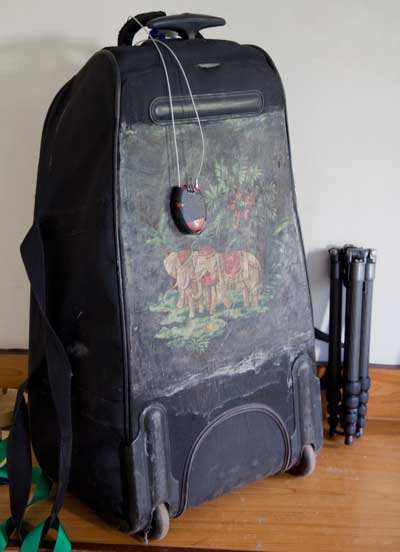
Bag with lock and tripod. There is a tradition in India of locking one's bag to one's train seat. Most backpackers carry, well, backpacks. I used to, but lately I've found that a bag-on-wheels and a day pack is better for my needs. Because I make movies I need to carry a tripod, camera, sound-recorder, lens cleaner, computer, media cards, external hard drives, cables, etc. So a bag-on-wheels and a day-pack that has my computer, adapter, water, snacks, camera, and sweater works well. The only problem with having a bag on wheels is picking it up and carrying it up and down flights of stairs and occasionally along muddy paths, etc. The big advantage of a bag-on-wheels is that it is comfortable to walk down the hall with it. It's easy to walk into a restaurant with it and stand it up by itself. With a backpack you always have to find a clean place to put it and occasionally one gets tired of putting it on, walking with it, and taking it off again. The bag pictured here is made by Samsonite.
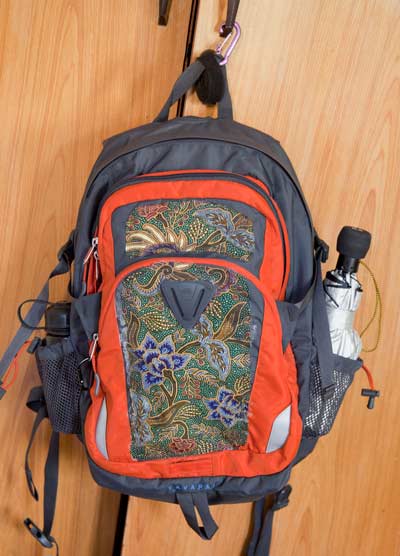
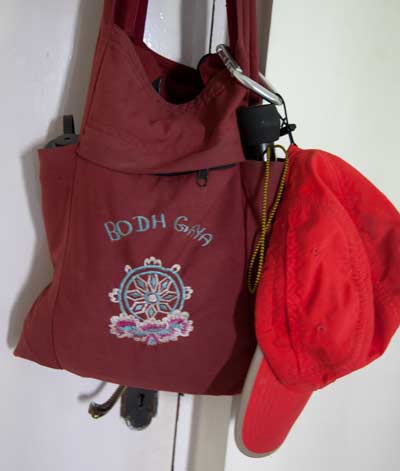
Day Pack with umbrella and water. Inside is a passport pocket, pen slots, and a computer pocket. My camera, the Canon 5D Mark III with a big lens, fits nicely in the front pocket with room for my sun glasses. Shoulder bag with umbrella, water, baseball cap. The carabiner that the hat is hanging from is useful for hanging the bag up, and, as you see, securing things to the bag. If I didn't have to carry movie-making stuff, I'd probably still be with a backpack. My favorite backpack was one of those that you could zip the straps away. That made it easy to put in luggage compartments, take on trains etc.
I've tried all kinds of day packs. As the equipment companies do more and more research, packs have become much more comfortable and durable. Recently I've been carrying the North Face Yavapai. I like it because it has no superfluous stuff, packs flat, is well-made, and is comfortable. Here you can see that I have put a piece of cloth over the ugly North Face logo.
ODDS AND ENDS
I carry a stuff sack for my pile or fleece jacket. It packs tight enough that you could use it for a football.
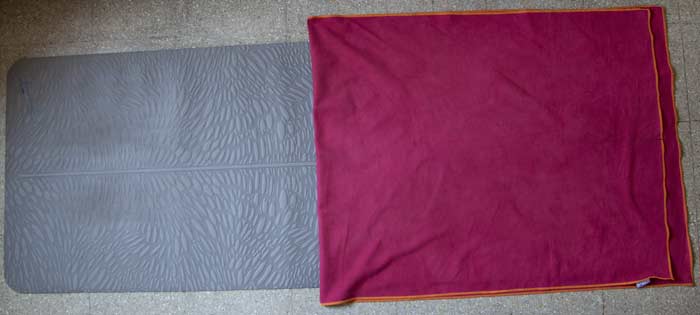
If you do yoga, you'll want to bring a yoga mat. Recently I've been carrying a Nike Yoga mat. It is very lightweight and yet soft enough to make the shoulder stand and the plow a breeze. I also carry the Manduka mat cover. It is a luxury item, but it sure feels good on my skin. It packs small.
I have three inflatable Therm-a-rest "sport seats" that I use as my meditation pillow. The Indian tailors can make very nice pillow covers for you.
Putting all of one personal hygiene items on one small zippered bag, one's vitamins and medicines in another, and one's electronic stuff in another woks for me.
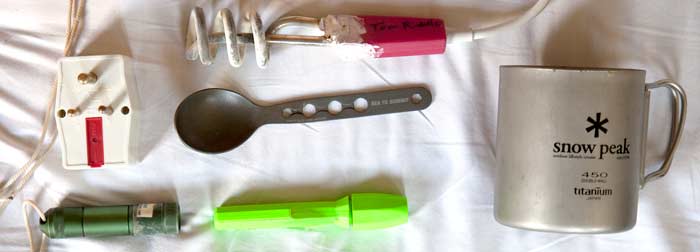
Indian plugs need an adapter to work with Western gadgets.
From left to right, clockwise: Indian plug adapter, immersion heater for boiling water, snow peak double-walled titanium cup, AAA flashlight, and AA flashlight. In the middle is my beloved Sea-to-summit titanium spoon.
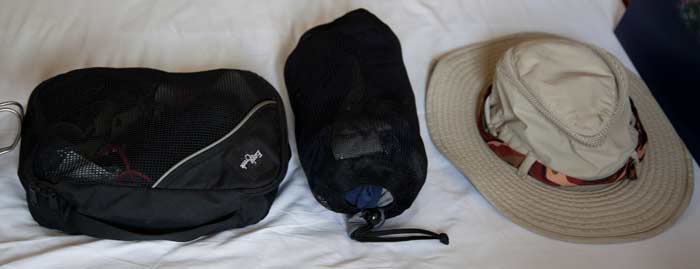
Eagle Creek makes my gadget bag. I don't who makes the stuff sack that contains the warm-as-toast pile jacket. Tilly makes my sun-hat, calling it the LTM6 AIRFLO. With this hat the heat, in theory, escapes in hot weather and does not build up on your head. It packs flat and washes easily, but if you want it to look really cool, you'll have to make your own hatband. If you have a lot of gadgets, consider a battery charger. They are small and allow you to stop worrying about carrying enough batteries to last the trip. If you look a bit, you can find high-quality non-rechargable batteries in India. Locally-made batteries are pretty useless. I've never seen rechargable batteries in India.
Carrying a water bottle that is easy to rinse out is a good idea. I put my inversion heater in my water bottle when I need to boil water.
You can buy, if you look for it, hand cleaner in India. Always, one way or another, clean your hands before you eat and after going to the toilet. Clean hands, eating a reasonable vegetarian diet that does not include anything fresh unless you know the restaurant or you peel it, and a good nights sleep are your best ways to stay healthy in India.
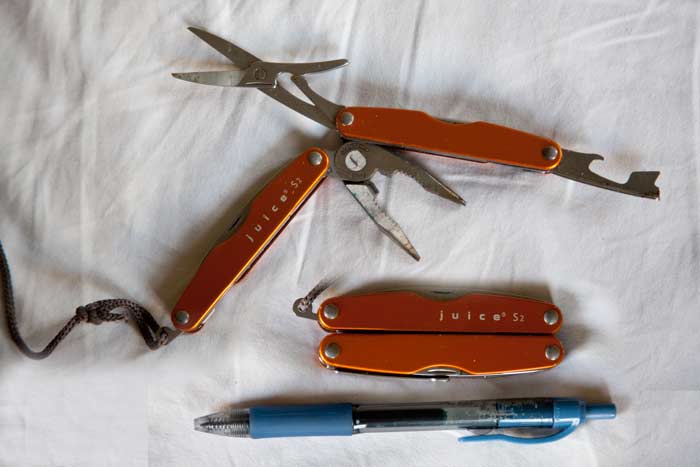
A pocket knife with scissors, knife, and bottle opener will come in handy. I carry the Leatherman Juice.
Having a medium-sized high-quality combination lock for the Indian hotel rooms that require them is a good idea.
Not all Indian hotels supply a towel. I like the quick-drying pack towels. But using your sarong (wrap around skirt) would probably work just as well.
CLOTHING
Let's start with shoes. On my first trip, I traveled in flip flops. These days I walk around in very good washable sandals and carry flip flops (shower shoes) for wearing at meditation retreats and in and around hotels. I also carry two pairs of socks. One pair is a light "liner" sock to put on when my feet get tired of the sandals—they can make a big difference. The other socks are thin quick-drying walking socks for cold weather and for, if I feel like wearing them, long walks.
If you want to wear shoes, and many travelers do, you'll have to carry and wash your socks. Besides socks, the disadvantage of shoes is that sometimes you'll have to take them off and put them back on many times a day as you enter temples, houses, and occasionally stores. Because I don't wear shoes, my feet are often dirty, but that doesn't bother me. If it bothers you, bring shoes and socks that will dry quickly. I've never picked up any foot infections, been bitten by critters, or cut my feet while wearing sandals in India. But clearly many travelers like the extra protection that shoes provide.
You can forget about shorts in India—they are not appropriate outside of the house. I travel with very light-weight tennis shorts that I wear while doing yoga and hanging out in the hotel. Some travelers wear pants that end halfway between the knee and ankle which means that they also have to carry pants for when the weather turns cooler.
Shorts that end just above the knee are popular in Thailand.
These days I travel with high-tech pants and shirts. They are comfortable in the heat, generally look more or less wrinkle free, and they are easy to wash. It's amazing how often you can just rinse them in plain water and put them back on, or, if they are really dirty, with just the smallest amount of detergent.
The big disadvantage of the high-tech clothes is that YOU have to wash them. If you give them to someone else to be washed they will likely be destroyed by people who don't know how to wash them. Ironically, my beloved Columbia Sportswear “Titanium” shirt is made in India.
I've found that just two pairs of high-tech pants are sufficient. I can rinse what I've worn that day, if they need it, and wear the other pair the next day. My pants and shirts have always dried by the morning. This last trip I wore the North Face Paramount Explorer #2, which are made in Bangladesh. They wear like iron, repel water, and are as durable as leather. Well, sort of. Recently I saw that that Prana Stretch Zion Pants have gotten very good reviews.
Underwear. The high-tech underwear that has become popular lately is not quite as comfortable as cotton, but it cleans easily, doesn't accumulate odors, and dries quickly. I found that three pairs are plenty.
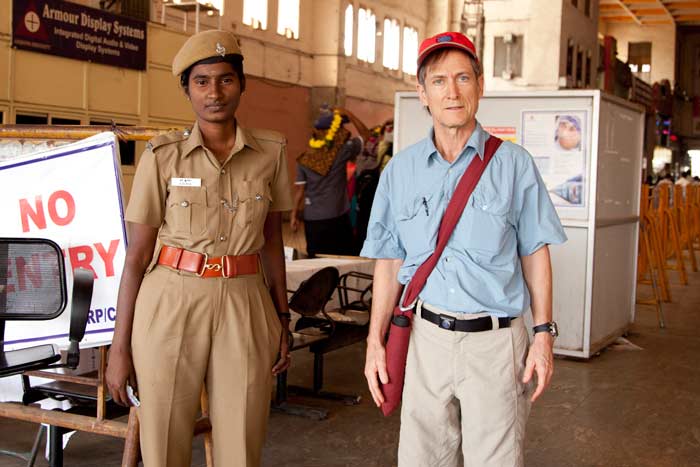
The author in his high-tech clothing next to a woman in her perfectly-ironed cotton uniform. I like to carry three button-down shirts with two front pockets. I carry my money in one front-pocket and my sunglasses and pen in the other. The pickpockets in Asia are pretty good, so be careful if you carry your money in your back pocket. I've found that it's good to carry one high-tech long-sleeved shirt with two front pockets. If it's cold you can wear it over a light pull-over, or, if you are going to be out in the sun all day, you can put it on.
I also carry two T-shirts. If it's cold you can wear one or you can wear one if you're just hanging out. It is inappropriate for men to be shirtless in India outside of the bedroom.
It is not appropriate for men or women to expose their shoulders or knees in public in India. Occasionally a younger Indian woman can be spotted wearing a sexy T-shirt in public, but most Indian women still dress very conservatively. Most India women and many Western women face the public wearing loose clothing that hides their curves or they'll wear a scarf or a shawl in public. In the last 20 years the groping of Western women by Indian men has decreased. (Twenty years ago I was groped by a guy who, in the early morning light, thought I was a woman!) Still, being cautious is a good idea. Recently I showed a group of Indian men a picture of a woman sitting alone in a park in New York City at night. The men were shocked. One of them commented that in India such a woman would be, as if she deserved it, raped.
If you carry a light high-tech "liner" sweater or pull-over, a light-weight pile jacket, long underwear, and a wind breaker with a hood, you should be pretty comfortable in most of Northern India, outside of the mountains, in the winter. If it gets really cold you can always buy a shawl or a blanket and wear that. In India wearing a blanket in cold weather is fine as is wrapping a towel or a large handkerchief around your head.
I carry a small umbrella to protect me from the sun and rain.
You don't need to carry a sleeping bag in India or Thailand although many people do. Hotels will have blankets and at least one sheet. Indian hotels don't always change the single sheet on the bed after guests leave. If that bothers you, you can carry a feather-lite sleeping bag liner and sleep in that. Many people carry a shawl or a light blanket.
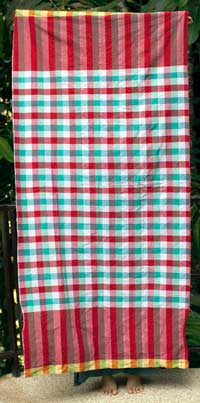
Sarongs come in all kinds of styles. This one is from Thailand. I like to carry a sarong, wrap-around-skirt, that can double as a bedsheet. Sarongs can be used as sun screens, towels, scarfs, hats, pillows, etc.
You'll need a sleeping bag in Nepal if you travel outside the major cities. You can, though, buy or rent one there. Nepal is a wonderful place, by the way, to buy all kinds of high-quality back-packing equipment.
I travel with two hats. I carry a collapsible sun hat and a baseball cap. When the sun is brutal, a sun hat is a life saver. Other times a baseball hat suffices to keep the bright light out of my eyes. If you're cold, you can always wrap your sarong around your head.
India can be frightfully dusty. Some travelers wear lightweight surgical masks which are available in India. Be forewarned, however, that surgical masks don't stop the really harmful pollutants. If you are serious about protecting yourself from the dust and pollution, bring a mask with a filter on it and look like Darth Vader, which won't bother anyone.
A mosquito head net is handy if you do meditation in places with mosquitoes or you end up sleeping in a hotel without screens on the windows.
Indian hotel rooms need to be cleaned as soon as you enter them. Indians traditionally live in dirt-floored huts, so the idea of actually mopping the floor is still a new concept in most places that I've stayed. To clean the floor, which you'll want to do if you do yoga or you don't want to wear shoes in your room, you'll need to carry a piece of cloth. Recently I've started carrying a micro-fibre cleaning cloth that was marketed in the USA as a tool to clean one's car. It cleans well without soap and dries fast.
Never take a room with a carpet—the floor will be dusty, filthy, and smell. If the room has an air-conditioner or hot water, be wary of electric shock.
PERSONAL ITEMS:
I've started carrying an electric toothbrush. The Indians have never seen one, so they think it's interesting. You can buy dental floss in India if you look a bit; it is easily found in Thailand.
You can buy high-quality soap and shampoo in India made by the Himalaya Herbal Healthcare company. Colgate toothpaste is also sold as are some multi-national body-care products. I believe that tampons are not available, although sanitary napkins are.
Aspirin and other common over-the-counter medications are available, as is, if you look for it, spirulina.
Working flashlights were not available when I first went to India. Now they import them from the Chinese. You might want to bring your own high-tech light though. If you bring something that has a glowing head, that might help people see you as you walk along dark roads. Often Indian streets are pitch black at night— you can't see who is coming at you and they can't see you. I have a AA flashlight that I keep tied to my pants when I go out at night. I sleep with it around my neck on trains and in dark hotel rooms.
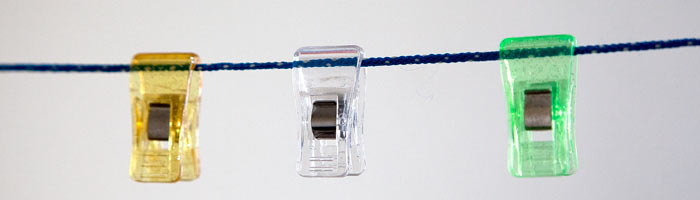
Don't forget some clothesline and clothespins. They'll come in handy. I carry a small immersion heater. This allows me to make tea and coffee in the light-weight titanium cup that I also carry. Believe it or not, I have a titanium spoon. After you live on the road as long as I have, you'll start carrying crazy stuff too.
Lots of tourists are carrying little computers these days. Now Indian second class air-conditioned trains have electric outlets. What can be nicer than whiling away the hours while watching movies on Indian trains and writing letters? In fact, the first draft of this article was written while traveling from northern to southern India on a 37-hour train ride. As the guys in my compartment charged their cell phones, had long cell-phone conversations, and played cell-phone music, I watched movies, and wrote stuff.
If you go to an Internet Cafe with a thumb-drive you can be pretty sure of picking up a virus. These days many hotels have wi-fi and many Internet cafes let you connect a cable directly to the Internet. If you will be in India for a few months you can consider buying a "dongle" that looks like a thumb drive. With this you can connect your notebook computer to the Internet.
Many tourists carry cell phones. A cell phone can make life dramatically easier in that with it you can call ahead and reserve a hotel room, check your e-mail, go-online, etc. If can join Clear Trip, you can even book a train ticket. SIM cards can be purchased and cell phone use in India is incredibly cheap. An aid worker told me that millions of Indians do not have toilets, but they have cell phones.
Most tourists have tiny digital cameras as well. In the major tourist centers your pictures can be transferred from your camera to a DVD. Please don't expect to find an Internet connection fast enough to upload your pictures to a digital storage medium in the clouds. Most of what you've heard about India being some kind of high-tech Shangri-la is a media myth. In most of India electricity supply is intermittent and unreliable, the roads are horrible, and the air and water are dirty.
MONEY
I carry a bunch of American hundred-dollar bills neatly folded into my fashionable Eagle Creek money belt. Make sure that you have relatively new and undamaged bills. Hundred dollar bills can even be exchanged in many supermarkets. Changing money in banks is possible, but often it means waiting in line and you'll need your passport. Travelers checks are harder to use these days. ATM machines are almost everywhere, but don't depend on them for emergencies — if there is no electricity they won't work and, this being India, at other times, for no particular reason, they won't work. Credit cards should not be used in restaurants and stores—there are too many con artists around.
Often you'll be asked for your passport and Indian visa. I carry a color photocopy of my passport in my wallet. Frequently that is enough for hotel staff who want to copy your passport details into their guest register. At other times you'll be asked to fill in exhaustive questionnaires as you check into a hotel. If you ever see my name with my occupation listed as “rock star” or “grave digger”, you'll know who it is.
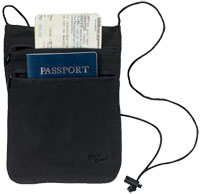
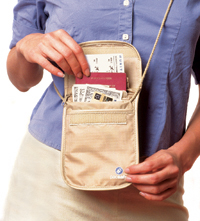
There are lots of ways to carry your passport and other stuff like your credit cards on your body. I used to wear my passport in a thick money belt, but that got to be too hot for me. So now I carry something like what you see here. Whatever you do, don't lose your passport. A while ago I scanned my passport and e-mailed it to myself. If I ever lose my passport, I can then open that e-mail and present that to the embassy. It sounds like a good idea, but I haven't had to try it yet.
Okay, I hope that all of this has helped. I'll end with a quote that once frequently hears as one travels in the third world, “Some people come here believing this is heaven. Others leave, knowing it is hell. But in fact it is neither. In fact, it is a purgatory where we are purged of our sins.” While we are being purged, India can be delightful. Enjoy your trip.

 top
top