In late August and early September of 2006 I visited Gabon, Africa to participate in a three-day bwiti, or spirit of iboga, initiation. It wasn't my first spiritual adventure.

In 1979, when I was 28, I did my first Buddhist meditation retreat. From the first I was hooked. I had the sense that the more meditation I did, the more I understood about how the mind worked, and the more peaceful and happy I became. I meditated for weeks or months in meditation centers in Thailand, India, Tibet, Burma, Australia, France, Sri Lanka, Japan, and the United States. Gradually, however, like a mountain climber who scales the same peaks year after year, I got a little tired of the same path. So I tried other things: kundalini yoga, spiritual healing, shamanic workshops, and even a weekend "Miracle of Love" workshop where everyone, an equal number of men and women, got naked.
In May of this year a friend suggested that I go with him to a workshop based on a traditional healing method from Gabon that involved the ingestion of the bark of the iboga plant. This was the same friend who recommended that I get naked to discover the "Miracle of Love." So I knew right away that this could be interesting.
I looked up iboga on the Internet. It is illegal in the US (isn't almost everything illegal in the US?), while legal in most of Europe. Apparently it has been used by the pygmies since the beginning of time. They eventually showed the non-forest people around them how to use the drug and it had a dramatic effect on the surrounding cultures. In Gabon even the president-for-life is an initiate of the iboga cult.
It is also mentioned by the ethnobotanist Terence McKenna as a possible candidate for the mythical tree of knowledge that resided in the Garden of Eden.
It all sounded good to me.
The workshop was three days in early July. At the end of it I told the leaders that nothing had happened. The iboga, which we had eaten in powder form, had simply given me insomnia. During my sleeplessness, I had done what I always do when I have insomnia: I meditated — specifically what Buddhists call "mindfulness of breathing." For two sleepless nights I had watched my breath. The leaders of the retreat told me not to worry, benefits would come.
A day later, after most people had already left the retreat center, I was walking to breakfast when I had what is called in Zen Buddhism a moment of satori, or awakening. From the area around my navel and spreading throughout the body came a deep feeling of security. Suddenly, it became clear that the ups and downs of my relationships with the people in my life had really nothing to do with my own deeper sense of peace and happiness because there was someone who loved me with an unfathomable depth and warmth. That person was me. Amazing. It was great to be alive.
Later I asked the teacher about it. The teacher said that I had worked through personality issues and old childhood patterns through meditation and that the iboga had taken me directly to the next step. In addition to the new security, the knee and back pain that had been bothering me for years had vanished.
"More," I thought. "I want more."
The teacher said that the next step was to go to Gabon and become "initiated." Then I heard that two English women, who did not speak French, were going to go. I felt that if the teacher was going to translate for them, then she could just as well translate for me. So when a movie-making job in Vietnam fell through, I decided to go to Gabon.
I kept a journal in a little notebook or, at other times, on a laptop computer.
Tuesday, August 29
Libreville, Gabon, Africa

The flight from Marseille, France, to Libreville took at least 12 hours, but who knows for sure — too many time zones. We had one stop, Casablanca. To me, the Casablanca Airport seemed to be jammed with every style of dress, skin tone, and nationality on earth. They all, though, had one common and unpleasant denominator: everybody smoked.
Anyway, the people of Gabon are tall, strong, and handsome and everybody walks like a statue. The people here are black, not tan, like African-Americans, but really black. Some of the women are drop-dead gorgeous.
I forgot my malaria medicine; I don't know how I could, but I did. On the street are all kinds of little businesses: barbers, beauty shops, tailors, garages, music stores, bakeries, and tiny grocery stores. McDonald's and WalMart have not made it to Gabon. Music is coming out of many stores: salsa, African, and some American pop music. The sewers are broken in a few places, and in other places there are no sewers, but who cares? No one cares. Everything is in slow motion.

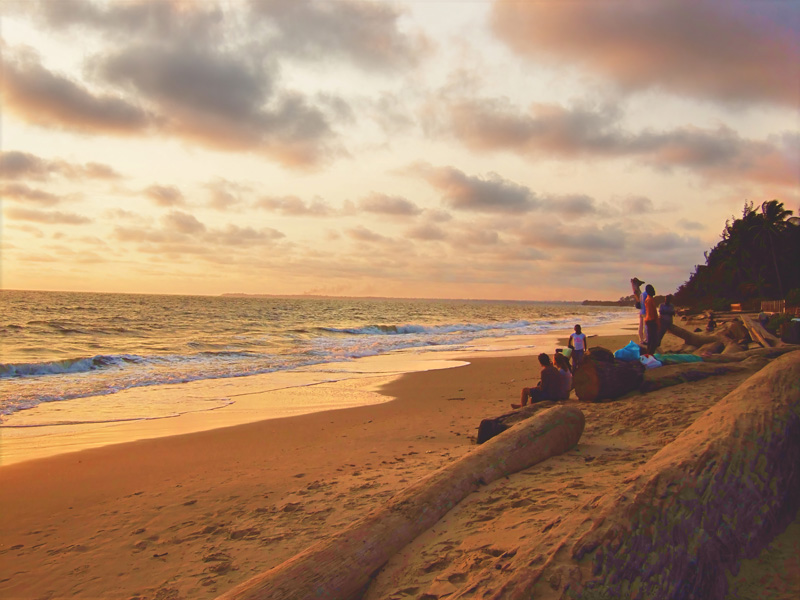
Libreville has some lovely beaches.
Eventually I reach the pharmacy. It is modern and one of the few places that is air-conditioned. The clerk is beautiful, and she's dancing to the music that is playing from the back of the store. Maybe not exactly dancing, but she's moving. She smiles at me. I write down the name of my malaria medicine. She waves and tells me in French to wait a minute. She waltzes off. In a few minutes she waltzes back with the medicine. I pay for it, she thanks me, and she's never missed a beat. What a country.
I'm traveling with four other people. Andrea is the leader, and this is her third trip to Gabon, her first as leader. In her mid-forties she looks like Marlene Dietrich. She is one of those people who started out in a dysfunctional family and then reinvented herself. Andrea says that Tibetan meditation gave her a center, the South American healing vine Ayahuasca gave her a sense of the divine, and iboga grounded her.
Elizabeth, who in her early thirties looks like a cross between Goldilocks and Snow White, spent ten years with a shaman in Mexico. In Mexico she recognized a Mexican man she had seen in a vision as her future husband. So she learned Spanish, married him, and had two wonderful children.
Candice I just met yesterday on the plane. She is in her mid-thirties and looks like a high-fashion model — a woman who could walk down the catwalk with a Fedora on and a long black evening dress. Everyone freezes and waits for her to take off the Fedora. She never does and no one cares: they've already been hypnotized. Two years ago, in France, she had her first taste of iboga. She makes her living as a back doctor.
Not only that, but for the last two years Elizabeth hasn't eaten cooked food. I've told her that if she survives Gabon without eating cooked food, she'll be my hero.
Wednesday, August 30
Second day in Libreville

Today Andrea took us to Libreville's biggest market, Mont-Bouet. A dirtier market in a big city, I have never seen.

Lesson number one was don't take any pictures without first asking. I saw some men carrying wheelbarrows full of what looked like freshly killed young deer. When I took a picture, the woman who owned the deer screamed at me, "Five thousand sifa for a picture." I started asking if I could take pictures; other times I took them very discreetly.

The ceremonial object section of the market reminded me of the Hogwarts School of Witchcraft and Wizardry. On display were rattles, drums, skins, dried lizards, stuffed animals, gorilla hands, bird wings, hundreds of unidentifiable potions, tiny coffins, and even a gorilla head.

A shopkeeper asked me what I thought. I told him that gorillas belong in the forest. "I think so too, my friend," he said. "But here in Gabon the magicians want to buy these things, so we have to sell them. We believe that with a gorilla hand you can hit your enemies from miles away."
"So why don't they smack George Bush?"
"He has too much protection." Protection, I've learned, means ways to keep the bad spirits away.

Before we left the market I ended up shaking hands with a severed gorilla hand. Mistake. Lesson number two: Don't ever shake hands with a severed gorilla hand: it will give you vivid and scary dreams featuring that hand.

Now the plan is that we will travel 14 hours by van to where the initiation will be — the village of Tchibanga in the far south of Gabon, about 325 miles or 520 kilometers away. And guess what? We get to cross the equator.
In addition to the five of us, eight other people will be making the trip. They say that they will be providing music. Today, we stopped for soft drinks in the house of one of them. Immediately they started singing, dancing, and playing instruments. The music alone could make this trip worthwhile.
Saturday, September 2
Arrived in Tchibanga
Our 7:30 AM departure began promptly at 9:30 in the morning, in a van whose suspension, we discovered when the paved road ended, stopped working years ago. After the suspension went, the seats broke, the door handles fell off, and everything that could possibly shake started to rattle. We only broke down a few times; most of our stops were at checkpoints where no one ever opened our bags, and most of the time they just wanted to see who we were.

Gradually the road stopped being paved and became a mess of potholes. Every village that lined the road looked exactly the same with a few one-story dusty wooden shacks with coconut thatch roofs. Day turned into night. The van was impossible to sleep in.

After the first fourteen hours in the van I was sure that our final destination must be around the next bend. Finally, 12 hours later, at 10:30 in the morning, it was.
Tchibanga is a town of about ten thousand people. As you approach it from a distance, it looks rather picturesque as it sits on a small hilltop. Only when you get closer do you realize that in spite of the fact that the town is laid out in a nice grid and the major roads are paved, it is a god awful mess of wrecked and abandoned vehicles and dusty broken down houses. A few of the abandoned cars now have trees growing out of them, which adds to the exoticness of the place.

From the customs checkpoint, it was just a short drive halfway up the Tchibanga hill, a turn off the paved road onto a dusty path, and there was, as proclaimed by a small billboard, "Le Monde du Bwiti, Zingo Magaurga" — in English, The World of the Spirit, hosted by Zingo the Healer. We unpacked the van, and Candice and I stepped inside the main room. I summed it up: "Candice, forget everything you know about normal living."

Before long, Zingo appeared — in his forties, trim, strong, and charming. He shook everyone's hand, said our names, and did what he could to make us feel welcome. His room has a double bed, a few shelves, a sound system, and some leopard skins on the wall. The room also has an assortment of ceremonial objects: rattles, ceremonial brooms, beads, horns, many old wine bottles filled with liquid iboga, a wine-bottle sized statue of the Virgin Mary, and a framed picture of the Blessed Mother. But the room is dominated by two life-sized posters of Britney Spears. I asked Zingo about Britney. His reply: "She likes to sing and dance. I like to sing and dance. What's the problem?"

No problem that I could see.
The temple is about the size of a four-car garage. One end is open with another exit in the back. The floor is dirt, but unlike the house, shoes are totally forbidden inside.

As I walked around the compound I saw a baby chimpanzee. Would she bite? I touched her head and she looked at me affectionately. Julie, it turns out, lives here. She passes her time slowly moving around the compound looking for food and things she can play with — like people's shoes.

That evening Zingo offered all of us a glass of liquid iboga. Zingo poured just a few ounces of the translucent dark brown liquid into a glass. One by one we drank it. As is the custom, first we kneeled, then he handed us the glass, we put one hand on our head, gulped it down, and then stood up with a ceremonial jump. The liquid iboga was amazingly bitter, much bitterer than anything I've ever tasted. I felt it go down my throat and into my stomach. One hit was clearly enough.
After dark Andrea announced that Zingo wanted to have a ceremony to welcome us. I pointed out that no one had slept in 36 hours. That, Andrea informed me, was something that was not considered. I asked Andrea how long the ceremony would take and was told, "All night. Every ceremony is all night."
The ceremony began at 10 PM with iboga, singing, and dancing. The music was wonderful, and — surprise — I lasted for three hours, at which time I found my way to my mattress, lay down, and realized that the iboga was still in control.
I couldn't sleep, even though my body was utterly exhausted. My eyes closed, but sleep and darkness did not come. Instead came patterns of lights and then, out of the patterns, I saw my late father dressed in his business suit. Somehow it seemed perfectly natural and I didn't think much about it — even though this was the first time in all my years of meditation to, well, see something.

At four AM, I realized that I was never going to sleep. I could hear the music from the temple, so I went back and stayed there until dawn when the ceremony finished. By the light of day I could see that Elizabeth and Cindy had stayed up all night, along with Andrea. Now, their faces were covered in dark red chalk.


All the technical words you need
The spirit or God. In Gabon and Cameroon people think that if you eat enough iboga, the spirit — the bwiti — will speak through you. Iboga and the Bwiti religion come from the pygmies, but these days the bwiti is heavily influenced by the Christian idea of God.
A male initiate of the bwiti religion.
Female initiates of the bwiti religion.
A musical instrument invented by the pygmies. It can be hypnotic.
Sunday, September 3
Tchibanga
I know that I slept at least a few hours, because while I was sleeping someone stole my flashlight — a Mag light I've carried for fourteen years — from beside me as I slept. The thief also opened Andrea's backpack and stole the medical kit.
The plan is that we can rest today, go to the market tomorrow, and on Tuesday we will go to the forest for the initiation. Zingo doesn't want to have the initiation here in Tchibanga because some of his gangas will sneak out for booze or come drunk. Now that he has stopped drinking, Zingo is a man on a mission.

Someone stole my shoes too. So Candice and I walked to the market. As we walked the neighborhood children shyly looked at us and a few of the older people stopped us to shake our hands. When we walked by the bars the guys called out to Candice. "Where are you from?" "Come here, my friend."


Tuesday, September 5
"We leave for the forest today"
Candice woke up still anxious about the initiation. Just to play it safe, we exchanged emergency contact information. Hey, why be stupid?

We left for the forest shortly after noon. The forest camp was actually quite beautiful — a fast-moving stream passed through a wooded valley that featured a temple the same size as the one in Tchibanga. This temple had unwoven coconut leaf walls and a flat roof that let in enough light to make it pleasant inside.


Washing clothes in the stream.

As dusk fell, I found a quiet place along the stream and did meditation for a couple of hours. The southern school of Buddhism has a systematized method of asking for and giving blessings before embarking on a journey. They call it metta, loving kindness. I found it very calming.
Before the actual initiation could begin, we had to have a series of rituals. The first ritual was the smoke sauna. I was carefully dressed in a red loin cloth that the men tied on me until it was like a diaper. Then at the appropriate time I was led shirtless to the back of the temple to join the women who were, much to my surprise, also shirtless. I was placed beside Candice. She looked like a Greek goddess as she stood topless in her long white pleated skirt. "Nice dress," I said.


Zingo began the ceremony by dramatically announcing that he had completely stopped drinking. His speech finished, the music began and he gave each of us about half a glass of iboga. It went down easily. A few minutes later came another half glass, and then a spoonful of iboga mixed with honey. I felt fine until the spoonful of iboga and honey slid down my throat. Suddenly my fingers were tingling like I had been electrically shocked. I was rapidly losing sensation in my body.

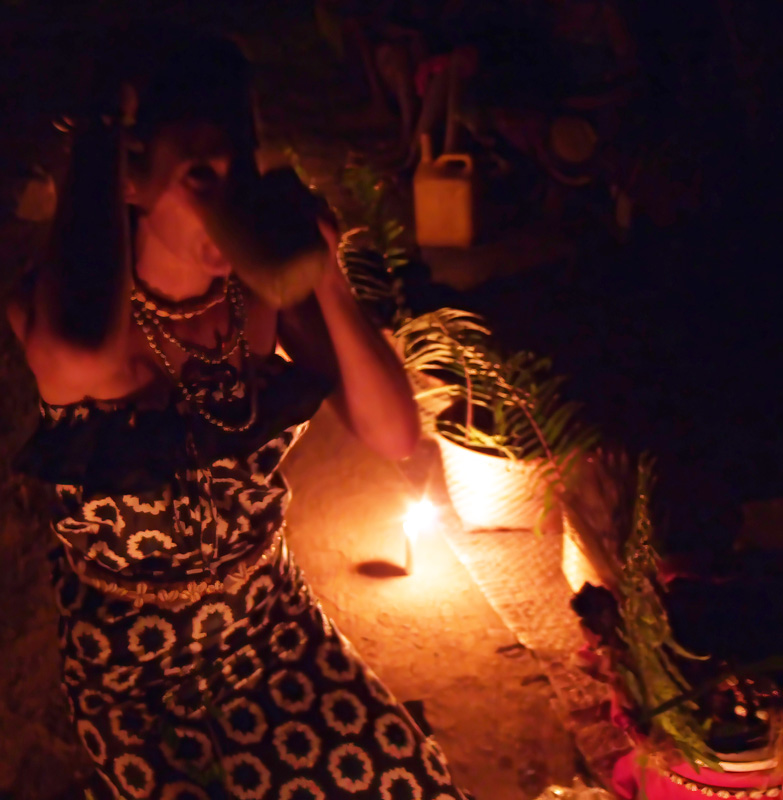
As I slid to the ground I looked at Candice and the other women and thought, Hold onto your seats ladies: this iboga is about to knock you flat.
Andrea moved her feet so I could put my head slightly under her chair. Once I got comfortable, she moved the chair away, and then someone lifted the coconut fronds off the roof to give me a clear view of the strangely reddish-looking night sky. There were a few shooting stars. It was peaceful and beautiful.
Then I heard Andrea talking as if she were right above me. I looked up towards her and as I did, I realized that my eyes appeared to be closed. What if I opened them? I forced my eyes open and surprise: the chair was still directly above me. I had hallucinated the night sky. Strange what iboga can do.
I closed my eyes again. This time everything went black. A minute later, however, a brilliant white sun flashed — a very bright white like burning magnesium.
Suddenly I had to vomit. I reached up to the bench, embraced it, pulled myself up, and moved my face toward the coconut leaf wall. From the bottom of my stomach I felt a huge hot cannon ball of vomit moving from my gut to my mouth. When it reached my mouth, I let go with a spew of vomit and a lion's roar. So much noise and so much vomit. Again, and again, and again. Finally I collapsed back to the ground, flat on my back.
On my back, things went white again — the white you see in movies when they test nuclear bombs. This time, however, the white faded to a gray fog and then that cleared to show a man sitting up in bed. He wasn't under the covers, rather he was sitting on the bed, calmly, sage-like, in his pajamas with his legs straight out in front of him. He was in a hospital or care facility. The man, who was in his 80s or 90s, was thin, and had white hair combed neatly to the side. Slowly it occurred to me who it was: this was me and I was witnessing my own death. Right now, just then, I died. Game over. It was a peaceful letting go of the life force.

Across the room was an elegantly displayed Japanese scroll. On the scroll, in English, was a poem written by a 19th century Japanese poet.
Oh look, how quickly
comes the night.
— Ryokan
As the words appeared, they scrolled up and away.
There was nothing particularly frightening in witnessing my own death. What happened next, however, was utterly terrifying.

Suddenly I was in a huge race track, but cars weren't racing by; instead all of humanity — or at least all of the humanity that I had ever known — was marching by. From where I was, I could see them coming from around a corner. I was too far away to recognize individual people except the leader: a person who had a striking resemblance to, well, Ronald McDonald.
I tried to look closer at the people passing by. But every time I got close enough for a good look, they would morph into someone or something else I could not recognize. This became dizzying so I went back to watching the entire parade. It was utterly terrifying. If you can imagine being in a rowboat at night in a hurricane, knowing that you are going to die as you row helplessly up one huge wave and down another, you'll get the general idea.
There were voices too. As people would parade by, two announcers would make comments. "He was a good guy." "He couldn't take a joke." "He worked hard to serve the community." "He always watched out for himself."
Physically I couldn't move. I was incapable of even lifting a finger. I was aware that I had a body; I just couldn't move it. The iboga had numbed and paralyzed my extremities and now it was shutting down the entire body. I was overdosing. This time I wasn't visualizing my death; I was experiencing it.
Later I learned that Andrea had thought the same thing: she was losing me. She called Zingo over. He put his hand just below the left side of my rib cage. I felt his hand and then I heard him say in French, "No, it's normal."
That should have been a tremendous relief, but the terror continued.
There was a road to the side of the race track. I got in a car and drove down that road. The road led to an American suburb of middle-class houses, not unlike where I grew up in a small town in Ohio. Suddenly I was back in Ohio and I was 16. There were my two brothers, teenagers as well: sitting at their desks in their bedrooms in our home, looking at me as I walked by their open bedroom doors, and grinning as they recognized me.
I could see myself at 16, 14, and ten, back in time until I was six or so. I was a teary-eyed little boy again. The boy looked at me and then turned away.
I got back in the car. This time I drove down a country road. Suddenly from the side of the road a huge black cat — perhaps a panther — jumped in front of the car. I hit it and killed it. Then, as I drove off, it came back to life, darted to the other side of the road and disappeared into the thick undergrowth.
It is impossible to estimate how long any of this took or even what was happening to me physically during this time.
From the beginning, as I lay immobile in the narrow aisle, different gangas would get up to dance or walk around. Occasionally someone would accidentally step on me. At one point Andrea even stuck one more spoonful of iboga mixed with honey into my mouth.
After a while Zingo decided that the ceremony had proceeded long enough, now it was time for the initiates to lie down on mats in the center of the temple. I couldn't move, so someone picked up my head, pushed my shoulders forward and somehow got me into a sitting position. I know this, because I saw it from a distance. I can't explain logically how I saw it, but I did. Once I was sitting, they picked me up by my armpits and dragged me a few meters to where the mats were.
Someone covered me with a blanket. Julie, the loveable chimpanzee, decided that the blanket and I would make a good place to sleep. Someone else, however, thought that this might not be the best time for Julie and me to bond, so they snatched up the stick I was using as a pillow, which bonked my head onto the ground. They then proceeded to beat Julie with the stick. Julie screamed, grabbed the blanket, screamed some more, and got hit again until she fled the temple.
Hours later Zingo decided that it was time for the women to go to the women's quarters. Andrea asked me, "Can you walk?"
With a tremendous effort, I moved my lips and whispered, "No."
One of the gangas hauled me to my feet and, holding me under my arms with his arms locked around my chest, forced my legs — like I was a puppet and he was a puppeteer — to plunk on the ground for over one hundred meters down the dark narrow forest path to the women's quarters.
Hours later I could hear birds singing and feel rain on my face. It is impossible to describe how emotionally draining all of this was.
Sometime late that morning I opened my eyes. The singing had stopped, but a battery-powered tape player was still playing iboga music. Candice opened her eyes and looked at me. I moved my lips and tried to make a sound. Nothing happened for a minute and then a shallow and hoarse voice allowed me to say, "Candice, I can't tell you how nice it is to see you."
"You too."
"How are you?"
She raised her eyebrows. Her face was pale and expressionless. Whatever had happened to her, it had been severe.
"You look good," I said.
"Thanks."
Sometime later I sat up. Later still I tried to stand up. One of the gangas saw me and rushed over to help. I reached for his arm: it was sturdier than a tree trunk.
Everyone tried to make us feel better. After the bath in the river, I could walk a few steps unaided, but I didn't want to go anywhere except back to my mat. I kept wondering, again and again, what had happened. Had I come close to death? Had I died and been reborn? Would I ever be normal again?
I could move my lips, but not very well. That was okay though — I didn't have anything to say.
After dark, for some reason everyone felt better. I ate a little more food and after the evening ceremony began I even had more iboga, a small glass and then some powder. Nothing was happening. The only thing I noticed was that shortly after my second dose, and not very long into the ceremony, I started to develop incredible night vision.
A few minutes later it became clear that I didn't have night vision at all: the sun was rising. Somewhere between my first and second dose of iboga, six hours had passed — and been lost. Totally lost.
After a breakfast of greasy noodles, I asked Candice to tell me about her initiation. She said that she had sat on the bench long after I was flat on my back. One of the African ladies told her to find a candle and stare at it. She did and presently a beam of pure white light emerged from the candle. On the beam was written, in French, "You are the light." After that, still on the bench, she had visions of her family that included the story of why her father's brother had become an alcoholic. She had never imagined that her family's history could be so dark. Along with the history came instructions on how to live — including giving up cigarettes, alcohol, and meat.

Now, well into day two, I started to walk around the camp a bit — taking pictures, talking to Candice, Elizabeth, and Cindy. Everyone was in a good mood. Once Julie saw me walking around, she approached me, put one hand up, and indicated that I should take her hand and walk with her around the camp. It didn't matter to Julie where we walked, just so we were together. When she got tired of walking, she wrapped herself around my thigh and we continued. Chimpanzees, or at least Julie, are remarkable.

Walking back to camp, I was suddenly exhausted. The only thing I wanted to do was lie down and close my eyes.
For the first time a woman's face appeared. It was a beautiful face, with clear skin, dark eyebrows, and beautiful crystal-like blue eyes. She looked deeply into my eyes and then turned away. After that, almost every time I closed my eyes, she would appear. I didn't recognize her.
Andrea told me that she was a kind of block, a trick. Whoever she was, she was beautiful.
The third night of our initiation was, we were told, very special. On this evening they would begin cooking the meal that we would eat on our fourth morning, the end of the initiation — symbolizing our re-birth as fully initiated gangas or maboundis. Preparations for the meal began with four women holding the chickens they had bought for us in their hands directly in front of them in the prayer position. As the women stood there praying, raising their hands and the chickens up and down, the chickens' necks swayed until, all at the same time, the necks of all four chickens snapped. The chickens had died in prayer.


Everyone felt good. This was our last night in the forest. Somehow we were all bonded closer together now. I was amazed at how incredibly sincerely helpful the same people I had dismissed as drunken thieves had been. They were doing everything they possibly could for me.
I decided to have one more hit of iboga. I asked Andrea if it was okay. She poured me half a glass, I drank it. If all of the other iboga I had tasted was dynamite, this was an atomic bomb.
The gangas took me to a little shack somewhere and placed me behind a small partition. I immediately splayed on the ground, totally immobile. It occurred to me that I could use my iboga psychic abilities to levitate above this room and look down on everyone. And that is exactly what I did.
From the top of the shack, the scene was eerily beautiful. There was one candle in the middle of the floor. The night was unusually calm so that there was no flicker from the candle, just a deep warm-gold light that created sharp shadows. The men were spread out around the shack. One man sat in the doorway, another in a low window, and two men leaned up against the wall. If ever black skin looked like polished ebony, this was it.
The night was unusually quiet. For the first time there wasn't any singing or even the sound of the tape player. Just then I heard someone snap his little fingernail past his thumb. A voice broke the silence, "Got a light?"
A stranger appeared — a local business and education specialist who had just come from a seminar. He explained that Gabon was now set for unprecedented economic growth, and asked if anyone might lend him 100 Francs. The stranger left. At the first light of day I realized that I had forgotten something in the shack. I got up to go back there — and realized there was no shack, and that this forest was too isolated for anyone to pass through it in the middle of the night. I hadn't dreamed it. But I was too embarrassed to say anything about it to anyone.
At our final ceremony, once, during a break in the dancing, I closed my eyes and wondered if I would see anything. Two lions appeared on a savannah. One of them roared and then they both walked away across the infinite plane. Somehow it all seemed very natural and I didn't give it a second thought.


The dancing continued until dawn.

Saturday, September 9
Back in the Real World

I slept for eight hours and woke up feeling alert. I did some meditation and yoga, showered, and walked back to Zingo's compound.
Now Tchibanga doesn't seem so bad. Yes, it still is a god-awful mess with junked cars everywhere and what looks like the total absence of what Americans call civic pride. But now it is clear that the junked cars are there because they are supposed to be there. They belong there, and what harm do they do? What matters is food, the family, visitors, good feelings. That kind of thing.

Walking around today, somehow, for some reason, the body felt good. It's hard to describe — just imagine how a panther feels walking close to the ground, gracefully, but ready to spring. Something had shifted.
Candice said that she had already been to the market, but it was too much: too many people around, too many goods, too many cars. She felt like most people feel when they finish a long meditation retreat and the brakes are off the senses. The good news was that she had called home on her cell phone and talked to her son. His first words were, "Mama I love you. When are you coming home?" All is well.
Andrea came in. We hugged. I thanked her for everything she did for me in the forest. Then I turned away; men don't like women to see them crying. I couldn't help it though. Zingo was right: Andrea is centered enough, knowledgeable enough, compassionate enough, strong enough, and insightful enough to lead initiations without him. She is a genius and a godsend.
Eventually I wandered into town and went to the Internet Cafe. Usually I think too much and feel guilty about being an American. But today that's gone. Andrea says that when we all get back to our normal routines, we will notice minor changes.
The shoes, that walked away the day after we arrived, walked back today. Not much wear and tear either. Good as new.


The police arrested Zingo and took him to jail. During the initiation one of Zingo's assistants had given iboga to a young man from Tchibanga who had come just to hang out. The man was blasted up to the sky and didn't come back down to earth. The man's mother went to the police, who decided that because Zingo was in charge, he should be arrested and jailed. Strange, too, because iboga is sold openly in the market in Tchibanga.


After paying a 300 Euro fine, Andrea and Candice got Zingo released. Justice had been served.
At our final ceremony I took a huge hit of iboga and hoped for the best. I trance danced — wildly moving your body to the beat and letting go, really letting go, until you enter another reality. I did it and felt a release: a part of me that hadn't opened before, opened up. You start moving and after a while you aren't moving any more: the music is moving you and you just have to let it do what it wants.
Everything finished after dawn with our graduation. That meant that, with a surprising lack of ceremony, the four of us walked out of the temple holding bucket-sized baskets that contained our "protection." The women were now maboundis and I was a ganga. No one shook our hands or said welcome to the club.
It was time to go. No one showered; we packed everything, gave away more possessions, more money, and hugged everyone.
One of the women said to me very seriously, "If you can come back, you are welcome. We will be right here." Another woman — the beautiful dancer who was over six feet tall — hugged me and said the first words she had ever said to me: "All the best."
Someone had tied Julie up inside the temple. I found a cup of water and handed it to her. She took the cup in her tiny hands and drank the water in one gulp. I said good-bye to her and her engrossing affectionate brown eyes. I knew, if she didn't, that in a few years she would be too big, too strong, and too aggressive to be a pet in this compound any longer. Good luck, Julie.
The ride back to Libreville took only 14 hours. All in all it was one of the worst days of my life.
We didn't lie down until 1 AM. Just as we did Candice asked me the only thing she asked me all day: "Can you still feel the iboga?"
"Yes." I could feel every vein in my body tingling with iboga.
"So can I."

I've been out of Gabon two months now. The best hospital in Bangkok says I'm better than ever with no malaria and no parasites. In malarial Tchibanga I never slept under a mosquito net, washed my hands after going to the toilet, or drank boiled water. In the forest we all drank directly from the stream. So a clean bill of health is appreciated.
The doctors missed a few things though. They didn't tell me why I can now do yoga poses that I haven't done for twenty years, or why — after more than twenty years of having a beer or a glass of wine almost every day — I haven't had the slightest desire to drink alcohol since I first tasted iboga five months ago.
Candice writes me sometimes. I asked her how she is. Yes, she really did give up smoking, meat, alcohol, and coffee. She was reborn, although she'll never say it.
She says that I might be the only person who can understand what she has been through. Can I understand what I've been through?
The three of us left Gabon on schedule, exactly three weeks after we arrived, and parted in the airport in Marseille. I walked Andrea to her car. Somehow the sky was bluer than we had remembered it and the air smelled like flowers.
A few hours later I flew to England and then back to Thailand. Two days later I joined a ten-day meditation retreat. I wanted to see if anything had changed. Meditation was still hard work. The only difference was now the body cooperated more. And then, after a week of meditation, when usually the mind manages to cough up parts of myself that I'd prefer not to see, there came something very different: a desire to wish everyone well.