In 1979, when I was 29 years old, I attended my first 10-day meditation retreat in the tradition of the Burmese meditation master U Ba Khin, a style that is now often popularly called vipassana. I had been persuaded to go to the meditation course by a friend at work, Dennis Ferman, who would, twenty years later, become an "assistant teacher" in the Goenka tradition of meditation.
Dennis was very convincing. He had served with the US Army in Vietnam during the war and had left the army, like so many men of his generation, cynical and depressed. He told me that when he first returned to his small home town in Kansas there was a banner across the street welcoming him back as a hero. But he didn't feel like a hero and shortly thereafter left to travel the world with no plans or a particular destination.
Eventually, Dennis joined the "overland to Asia" crowd and after many misadventures found himself on a ten-day meditation retreat taught by one of the students of U Ba Khin, S.N. Goenka. In those days, Mr. Goenka did not have any meditation centers — he would simply rent an entire hotel and have his 10-day meditation courses there.
Dennis quickly took to meditation and completed course after course. Unfortunately though, in Nepal, he contracted a severe case of amoebic dysentery that, like meditation, would forever change his life.
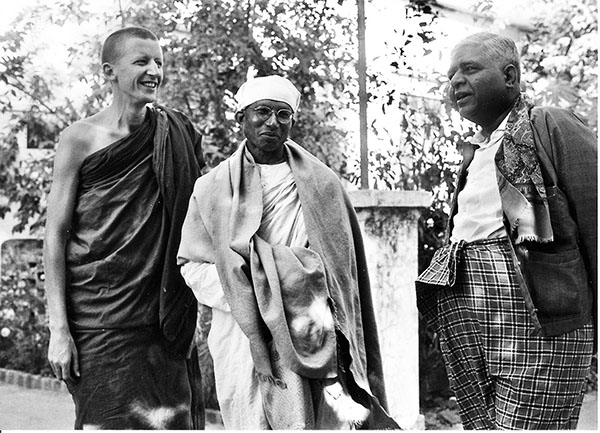
The first retreat I attended was lead by an American, John Coleman, who, along with S.N. Goenka, Robert Hover, Ruth Denison, Mother Sayama, and others, had been authorized to teach meditation by U Ba Khin shortly before he died in 1971.
For me, that first retreat, what many people call "a course", was, like it is for most people, a very powerful experience which I wanted to repeat. So, seven months later, following Dennis' very well-planned itinerary, I made my first trip to India and had the good fortune to attend a retreat with Mr. Goenka himself. In 1976 Mr. Goenka had established what was then his only meditation center at a railway junction north of Bombay, Igatpuri. He called the center Dhamma Giri.
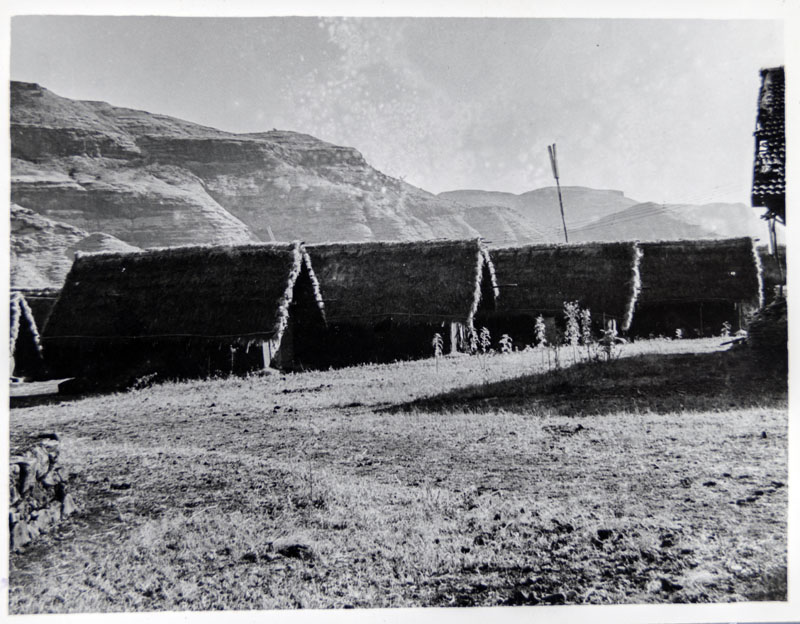
Now, in 2022, Dhamma Giri is jammed with gardens, trees, and buildings, but in 1979 all of the meditators stayed in simple mud and leaf huts and the only concrete buildings were the dining hall, an administrative building, the toilet/shower complex, and the newly-completed meditation hall.
During the retreat, I realized that if I ever had wondered what it meant to "be in the presence of a saint" my question had been answered when Mr. Goenka entered the meditation hall. He had an overwhelming presence.
Most of the meditation sessions were done as a group in the huge meditation hall, but occasionally we would be sent, in groups of about five people, to meditation cells that lined the main hall. One day Mr. Goenka went from cell-to-cell asking people how they were doing.
As he opened the door of the meditation cell I was in, he seemed to tower above me as I sat on the floor beneath him. His question to me, which he asked in his deep resonant voice was, "Do you have any thoughts?"
"Yes," I said
"Are they of the Buddha?"
"Yes."
"Continue."
I continued.
It was amazing. In the presence of Mr. Goenka, I only had thoughts of the Buddha and how wonderful his teachings, as taught by Mr. Goenka, were.
After more retreats in India, I did one more retreat, this time in England with another "authorized teacher" Mother Sayama, a very lively and sincere Burmese woman.
So far so good, but one thing I always disliked was the prohibition of doing yoga during the retreat. I have heard that these days meditators are allowed to do yoga in their own rooms, but there still is no time on the schedule for yoga or exercise. I've been told that often assistant teachers develop serious knee problems just because they don't do anything to help their joints.
Back to our story, when I returned to the USA in 1980 I felt that I was now fully established in what was surely the best, and most powerful, meditation technique on the planet. I explain the technique in a footnote, here. I was supremely confident and felt virtually bullet-proof. Meditation was going to, I was sure, help the rest of my life flow smoothly along. My confidence was helped by the fact that I sat every morning for an hour and at least a little in the evening.
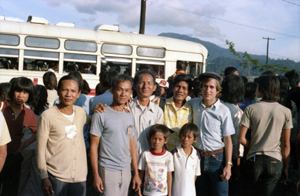

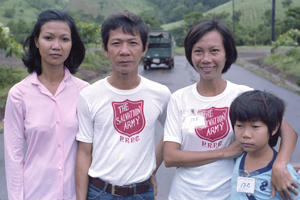
With so much confidence, believing that I could handle almost any situation, I signed up to work as a supervisor of English teachers in one of the refugee camps that had been set up in Southeast Asia after the Viet Nam War. (I had taught English as a Second Language for a few years before that.) It was 1981 and about a million traumatized people were fleeing Vietnam, Cambodia, and Laos. My employer would be the US State Department who decided that I should be sent to a "camp" in the Philippines.
It turned out to be a very tough job.
Every six months twenty thousand refugees rotated into the camp from refugee camps in Thailand and Malaysia and then out of the camp to the United States with a few going to Canada, Japan and a few European countries. During those six months, they were given some basic English instruction and "cultural orientation" that was designed to help them smoothly integrate into American society. In other words, my job was to help refugees get off welfare and get a job. The teachers I worked with were Filipinos. To them the housing and living conditions in the camp were the best they had ever experienced; to the Americans, all 21 of us, the housing and living conditions were the worst we had ever seen. In my dormitory 14 people lived in seven poorly built rooms, with two toilets, two showers, one two-burner stove, one kitchen sink, and one refrigerator.
The young Americans, like me, had also never worked in so much corruption, confusion, and in-fighting. After six months many of my American co-workers began to feel that we were soldiers on the losing side of a never-ending war. Nevertheless, I kept up my meditation practice even as I saw some of my colleagues fall into heavy drinking and promiscuity, I thought that I was doing okay. Here is a crude example of how bad things became for some of my colleagues: my direct boss, who was married with a wife and young child, one night went to a bar and as he sat at a table drinking with his friends, he paid a woman to crawl under the table and give him oral sex. His behavior seemed, at the time, strikingly normal. After about ten months, my boss's boss, the head of the entire multi-million dollar program, had to be hospitalized for problems related to alcohol abuse. After hospitalization, he resumed his work and his drinking.
My contract was for a year, but to finish a project I was working on, I stayed for an extra month. When I finally left the camp, even though I was never medically diagnosed, I now believe that I was suffering symptoms of a nervous breakdown. My symptoms included the feeling that I was living in a nightmare that I was never going to wake up from. I remember having what I called, "day-mares" which were nightmares but in the day time. From time-to-time every day my mind would seemingly fall into a very dark place filled with a lack of self-worth, hatred, anger, violence, and other forms of suffering. Naturally this affected every aspect of my daily life in a negative way.
At that time though I didn't understand what was going on and I was still convinced that if I did enough meditation I would be, like Dennis before me, healed of my wounds. Fortunately, I was able to travel straight from the Philippines to the nearby Buddhist country of Thailand where it was easy to find places to meditate. After a few days in the country, I was able to begin a two-week self-retreat where for the entire time I was completely frozen, internally locked up. I clearly remember one afternoon sitting in meditation for four hours without moving and without experiencing a single sensation in my entire body. I simply was totally numb from head to foot.
Later I did two more retreats and nothing happened. Meanwhile the feeling that I was living a waking nightmare continued.
In spite of all this, my faith in what the "vipassana" teachers had taught me was unwavering. In other words, I was completely and helplessly brainwashed into believing that Mr. Goenka's method was the ultimate solution to the problems that come with being human.
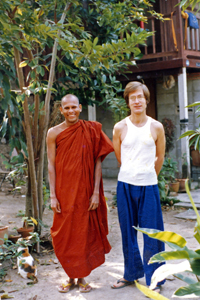
Then one day I went to another Buddhist monastery and asked the abbot for permission to stay for a week to do meditation.
"And what kind of meditation do you do?" he asked.
"I do vipassana as taught by U Ba Khin."
"That's fine, but you can't do that here."
"What can I do?"
"If you stay, we will teach you."
I had nothing to lose, so I stayed.
I shortly learned a style of meditation that had been taught by another Burmese meditation master, Mahasi Sayadaw.
With that technique, one has an object of meditation and one simply tries to keep the mind on that object. When the mind wavers, one simply returns to the object. If thoughts or sensations persist one notes whatever is going on. If one gets many thoughts of anger, for example, one can just mindfully note, "anger." Or if pain arises one can note, "pain" and then study that pain as one would study, with a non-judgmental awareness, an Asian lizard moving on the wall. In that tradition, there is also a technique which Mr. Goenka had labeled as "madness," walking meditation. Much to my surprise, I instantly connected with the walking meditation and found that it helped my concentration for the sitting meditation where the main object of focus was watching the rising and falling of the abdomen.
After 10 days of practicing the Mahasi Sayadaw technique, I felt as if I had just gotten off a hot stove and walked into an air-conditioned room. What a relief. The incredibly negative thoughts did not totally disappear, but they had moved to the back of the room. I could smile again.
Nevertheless, there was still a part of me that wouldn't let go of Mr. Goenka's sweeping technique, which he mislabels "vipassana." Often I would think, "What if the sweeping technique really is the one and only meditation technique that works? Maybe I should be doing that." It would take me a few more years to totally let go of that attachment.
When I told one of the Western monks who was practicing at the monastery about my experience, he suggested that I go to India and study with his favorite meditation teacher, Christopher Titmuss.
So I went to India and did two ten-day back-to-back retreats with Christopher. As the twenty days ended, after the hurricane of negativity that had initially arisen, I was in an ocean of calm.
I have continued with that kind of mindfulness-based meditation virtually every day ever since, now going on 50 years.
Later I learned that my experience with Mr. Goenka's technique really wasn't so unique. Often the initial experiences at his meditation centers are so dramatic that people are convinced that what Mr. Goenka teaches is the "one-size-fits-all" solution to all of the problems that come with being human and donate their fortunes to the cause. Later, however, like my good friend Dennis Ferman, they continue the practice even though not much happens—for them, the meditation has become like pushing against a huge wall that will never move, nevertheless, they continue.
(Were we all duped by a cult? To me there are striking similarities between what happened to me and what happened to be a male super-model, Hoyt Richards, who was sucked into a cult that took him years to break away from. He told his story to the BBC.)
Over the years Mr. Goenka, who died in 2013, and his organization changed.
Eventually Mr. Goenka separated himself from all the other teachers "authorized" by U Ba Khin and set up his own organization and that organization has, from what I can tell, become more demanding, authoritarian, and some would say cult-like. Gone are the days that one could simply show up at a "vipassana" meditation center and do a retreat. Now everyone is thoroughly interviewed and my understanding is that students are not permitted to experiment with any other techniques.
A few years ago, I met a young woman who said that she was going to attend a retreat in a Goenka center. "Get ready to be brainwashed," I told her.
"You are the third person who has told me that," she said.
Another time I met a Western Buddhist monk in Thailand who had studied with a range of Buddhist masters including Mr. Goenka. I asked him what he thought of the sweeping technique as taught by Mr. Goenka, "I can go to any place in my body," he said, "and get a sensation. So what?"
That, in the end, is my experience as well. So what?
Meanwhile, Dennis Ferman and I stayed in close contact until his death in 2016. The amoebic dysentery that he had contracted in India eventually beat him. Dennis put up a heroic effort but eventually, his system simply gave out. I wrote a memorial to him which you can find here.
If any students of Mr. Goenka read this I would encourage you to simply have an open mind. When you feel that you've taken the technique as far as you can take it, let it go. There is another world of meditation ready to welcome you. You will find that, with the help of the sweeping technique and the breathing technique that Mr. Goenka teaches, you have cultivated some useful mental states as well as confidence and discipline; now you are ready to begin anew.
If you have any comments you can e-mail me at thomasriddle at gmail.com.
I wish you all the very best. — Tom Riddle, 2026
Notable former Goenka students
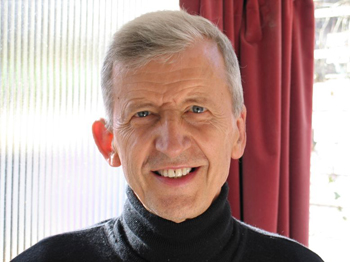
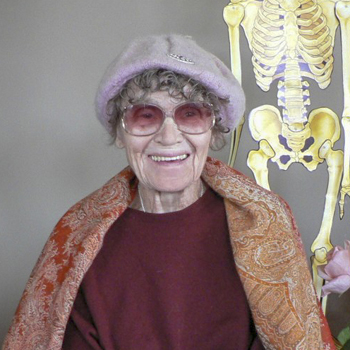
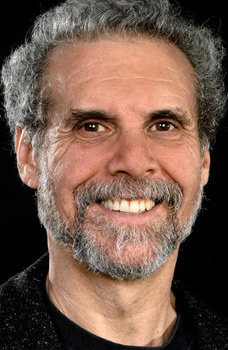
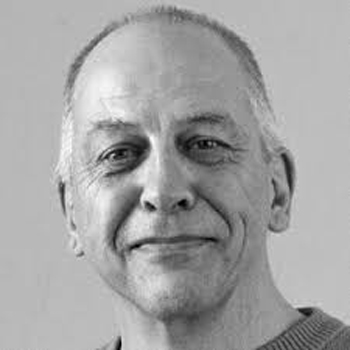
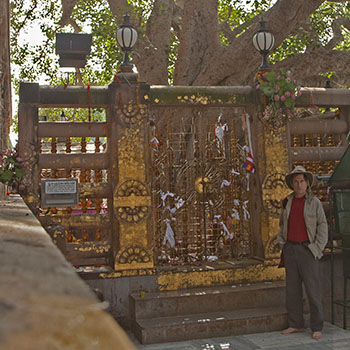
Over the years I've met or heard of other former Goenka students who have gone onto great renown in the meditation world. It's been heartening to see that I'm not the only person who has felt that although the sweeping technique was initially useful, ultimately it was not enough. The only thing that the people pictured below really have in common is a love of meditation and the fact that they no longer use as a main focus the sweeping technique. (I've collected the pictures from around the Internet.)

Footnote — The Sweeping Technique
The technique that S.N. Goenka called "vipassana" is a body scan or sweeping technique. Many other teachers teach something that is similar as a useful technique, but no one says that it is the "best and only" technique. For a good example of the sweeping technique listen to Leigh Braisington give this guided meditation that was taught to him by Aya Khema. You can think of the sweeping technique as doing yoga nidra (deep relaxation after yoga), but sitting up.
Mr. Goenka has students slowly sweep through the body from head to foot and then foot to head. He claimed that what he taught was exactly what he had been taught by U Ba Khin. John Coleman, another "authorized teacher" in the school of U Ba Kin taught sweeping but John only "swept" from head to foot and then started again. Again, he claimed that he was teaching exactly what U Ba Khin had taught him. Finally, another of U Ba Khin's students, Robert Hover, would have students sit, without moving, for marathon sessions of two, and even three, hours.
Mr. Goenka and another of U Ba Khin's students, Mother Sayama, worked together for many years but eventually stopped communicating because they could not agree on what was the proper meditation method. These days students of S.N. Goenka are forbidden to meditate in the centers established by Mother Sayama. You can find more about the meditation centers of Mother Sayama here.
If you want to read my take on meditation these days, please see thomasriddle.net/books.
I wish you peace and happiness. — TR, 2026
PS. After writing the above I heard Daniel Ingram, the author of "Mastering the Core Teachings of the Buddha" speak on a podcast and explain, using his own words, why he thinks the technique does not work for so many people. You can hear the interview here: https://youtu.be/eZ_sTcIKJNY?t=3287
Or read the below.
I have an inside scoop from a friend — I don't know if they would want me saying their name so I'm just gonna say I know someone who was also there back in the day when U Ba Kin was teaching Ruth Dennison and Robert Harry Hoover and Goenka and the two others — this woman and another guy whose name for whatever reason I'm blanking on at the moment (TR: probably John Coleman), but the point is that U Ba Kin taught all of them from the Visuddhimagga, which is a big meditation manual about purification — you can look it up it's a free download online. It's a great hog of a cumbersome text, but amazing. It's sort of like an encyclopedia and he would look at each of these practitioners who were all different. They all had totally different styles, different needs, and he would teach them each different stuff that was appropriate to them. What's interesting is that since he was teaching them each individually — apparently, back in the day, none of them realized the degree to which U Ba Kin was giving them all something that was very very custom-tailored for them — for what was going on with them — they're difficulties, for their strengths, for their goals, for their personality style because the Visuddhimagga has all that technology built into it about different techniques for different types of people and different remedies for different imbalances.
He was combining that with his own insight and training and wisdom and skill and crafting some custom tech for each of them. And apparently, they all, after studying with him, tried to teach together initially (and) apparently it was a mess. It was because they hadn't realized how different they were each being taught and they were saying things that were totally different, totally — totally at odds.
So they apparently rapidly all went their own ways. And apparently, Goenka did not have Dark Night problems. He was a re-assured, confident, powerful person whom the Dark Night and the maps were not much of a thing for. Furthermore, when he taught — I know some people who sat with the man back in the day — people who now know the maps, and they said his presence, his confidence, his reassurance his energy, somehow transmitted and something about that just carried people through the hard stuff.
He inspired so much faith that people just did the techniques; they kind of got this transmission, this resonance, the support by his energy and his own faith and confidence and competence. And so they didn't really need any of that when he was around apparently, so I've heard.
Goenka didn't need it for his practice, he wasn't taught it and people he was teaching, because of him — apparently he was sort of part of the secret sauce that made this map-free combination work. They didn't really need it because of his support. He held them in this space of like, you know, this big confident Indian guy.
They didn't recognize that without him and in some practitioners it might have been incredibly relevant to have this tech. And then Goenka said, "If you don't change the tradition and you keep it just like I've taught it — you keep the videos and you keep everything the same then it will last for 500 years or something. And if you don't, then it will degenerate." And so there came this notion that they shouldn't touch the tradition which I get. They respect their teacher and he said it. And Goenka was impressive and he created this amazing organization and he helped a lot of people so I understand where the conflict of the tradition comes and but that said, I really still think it's time for a change and I know that annoys the tradition and it creates the possibility of a split.
And that absolutely sucks and like what a mess. I can't help but have my opinion based on my own experience of having conversed and written back and forth to countless hundreds of people who have had serious downsides from not having these stages normalized for them and explained.